
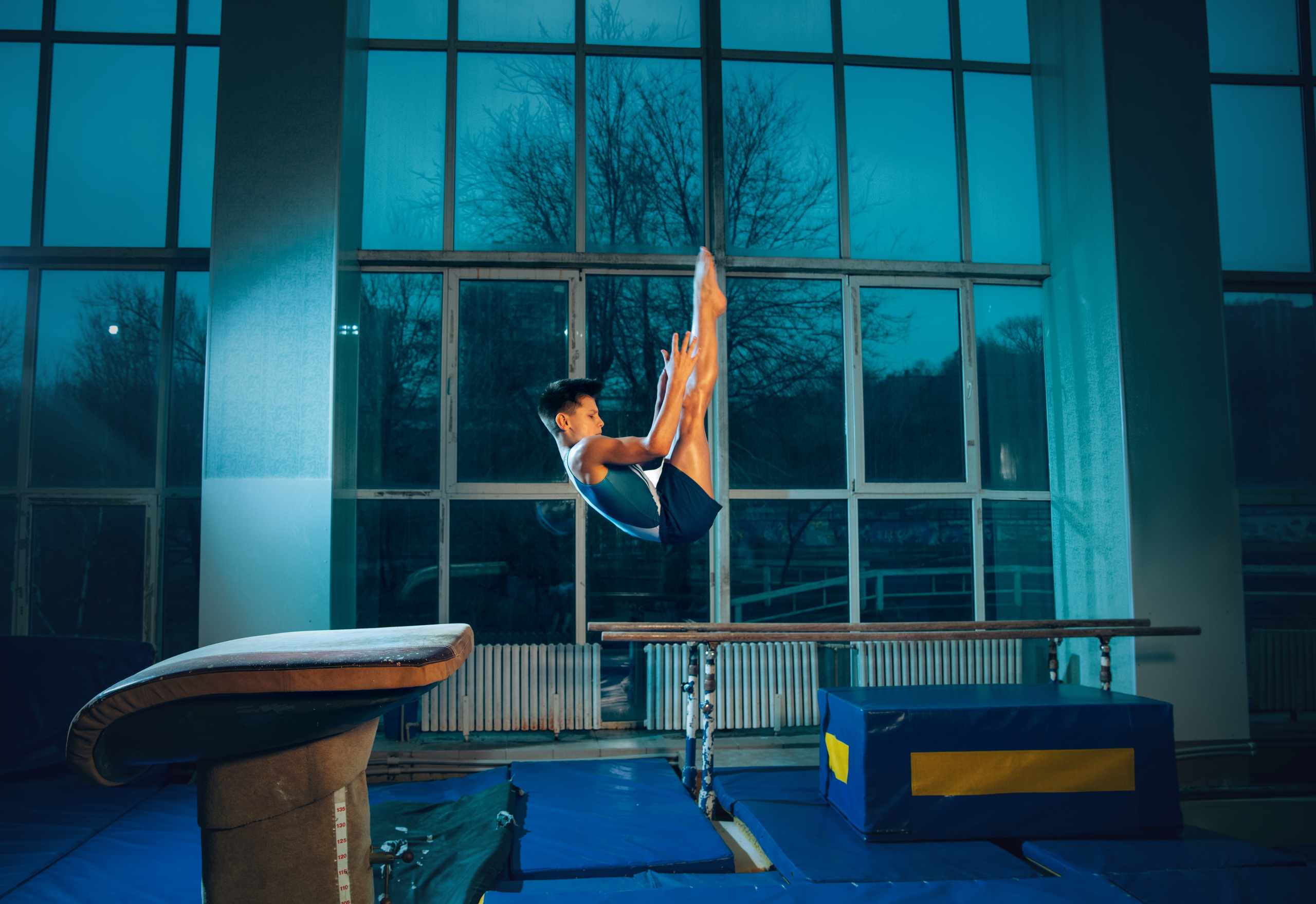
Jumps are very common moves in rhythmic gymnastics and can be hard to learn. The first jump is simply to jump up off the ground. If your gymnast is a beginner, she should be able to stand balanced after the jump without taking any additional steps. The legs should not buckle inward, she shouldn’t fall forward upon landing, her arms shouldn’t swing wildly or her body sway to the side. If your gymnast has any of these problems, the jump should be much smaller so she can balance well after the jump.
Take Off
When preparing to take off, your gymnast should be standing balanced with weight evenly on both feet and her upper body should be straight. She should be able to hold this position easily. When she jumps, her knees should point where her toes point, not buckle inward. Her lift should come from her legs, feet and ankles and it should be more like a long extension than a jerk. When she is in the air she can point her toes (do not let her try and force this while still standing on the floor, as she may jump weaker this way).
Practice
Your gymnast should practice this small vertical jump a few times in the same spot. Have her hold after each jump and make sure she is balanced.
Landing
When she lands she should land on the balls of her feet first. She should give a little with her feet (not let them just slam into the ground) and her knees should give a little too. Her upper body should be well organized so that it won’t fall forward. If she is landing with her knees and ankles absorbing the landing properly, it will actually be much quieter than if she just lands hard into the ground.
Progression
Once she can do this easily, then you can work on more complex jumps. It’s more important that she can repeat this jump easily and land balanced and quietly than it is for her to jump high in the beginning. If at any point during her training the height of her jump starts interfering with her balance or the quality of the landing, you should go back to smaller jumps. She should also stop this exercise as soon as she’s tired, or if her landings get sloppy. She should also be able to use this jump in a simple combination (steps, prep, jump, ending, hold for 1-2 counts of music). Her landings in these combinations shouldn’t be shakier than during the individual exercise. All jumps should be done on a good non-slip surface.